Research
Tomography turns the measurements a scanner makes into an image of the inside of an object. Doing that well is an inverse problem: the data are incomplete and noisy, the scanners are imperfect, and the datasets can be huge. Our work runs from the mathematics of reconstruction, through GPU algorithms and open-source software, to real scanners in hospitals, laboratories and industry. It falls into four themes; each links to example images in the Gallery and to all its papers.
Learned reconstruction you can trust
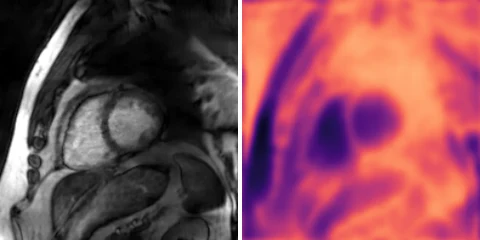
Machine-learned reconstruction does well on benchmarks, but in practice clean training data are rare, real scans differ from the training set, and the result comes with no measure of how far to trust it.
- Learning without clean data. Self-supervised reconstruction when only noisy measurements exist: Noisier2Inverse for correlated noise, and DREAM, which learns spatially adaptive regularisation maps from the scan itself.
- Knowing how uncertain a result is. Geometry-aware diffusion posterior sampling for sparse-view and limited-angle CT gives both a reconstruction and a map of where it is unreliable.
- Testing on real data. A benchmark of 12 learned methods on 9 problems using measured data, a study of learned denoising on simulated and experimental low-dose data, and the ICASSP 2024 challenge on low-dose 3D cone-beam CT that we organised.
- Reconstruction for the task. Joint reconstruction and segmentation, where the image is optimised for what it will be used for.
- Reproducible software. LION collects learned reconstruction methods, CT operators, datasets and trained models in one place.
In the group: Troy Vu, Andrea Sainz Bear, Honglei Brinkmann.
Images in the Gallery and all 17 papers on this.
Fast, large-scale and real-time CT
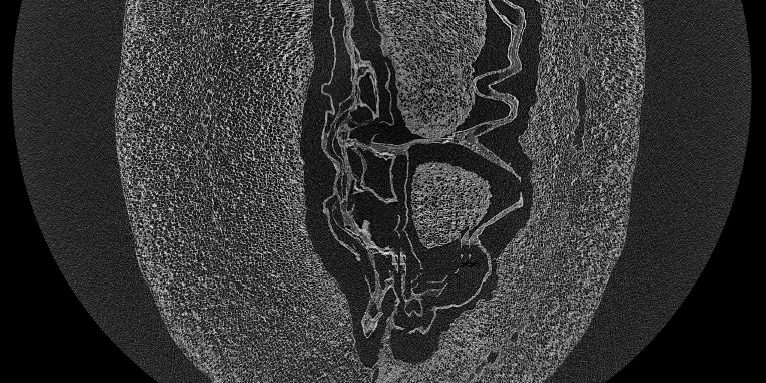
Iterative reconstruction gives better images than filtered backprojection, but at the size of modern micro-CT, synchrotron and industrial scans it was too slow, or the data did not fit on a GPU at all.
- Open-source GPU reconstruction. TIGRE has more than 550 citations and is used at universities, national facilities, hospitals and companies; it is also a reconstruction backend of the Core Imaging Library. TIGRE v3 adds over 25 algorithms and loaders for real data from clinical and industrial scanners.
- Larger than GPU memory. Reconstruction of arbitrarily large datasets on one or several GPUs, such as a 4000 × 4000 × 1000 voxel scan on a single GPU.
- Fewer iterations. Krylov subspace methods converge in a handful of iterations, and make real-time reconstruction during repeated scans possible.
- Faster industrial CT. Fast X-ray CT from a limited number of projections and its effect on dimensional metrology.
- Beyond voxels. Projectors on tetrahedral meshes, so the resolution can follow the object.
Previously in the group: Fred Vickers Hastings.
Images in the Gallery and all 16 papers on this.
Imaging in the clinic
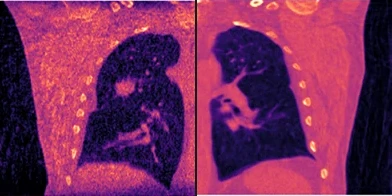
Methods from inverse problems often stall before they reach patients: the software is missing, the data are hard to get, and the fields rarely talk to each other. We work with clinicians and medical physicists to close that gap.
- Low-dose and motion-compensated CBCT for radiotherapy. A general method for motion compensation in CT and GPU iterative CBCT for lung radiotherapy.
- Better scanner trajectories. With Sepideh Hatamikia’s group, trajectory optimisation for cone-beam CT and for dental imaging beyond the usual field of view.
- Image quality as clinicians see it. Why common image-quality metrics fail on medical images, and CBCT-IQ, a public annotated dataset for image-quality assessment.
- More than CT. Patient motion in whole-body dynamic PET, limited-angle breast CBCT with photon-counting detectors, and uncertainty quantification across the MRI pipeline.
In the group: Padmini Krishnadas.
Images in the Gallery and all 48 papers on this.
New uses of tomography
The same inverse-problem tools work well outside the hospital, often on data with very different physics. Much of this is industrial CT, where scans are large and time on the scanner is expensive.
- Industrial CT and non-destructive testing. Benchmarking reconstruction algorithms for industrial cone-beam CT, artefact reduction in fibre-reinforced polymers, and non-destructive testing of aircraft composites.
- Laminography for flat objects. Resolution of a laboratory laminography system and LamiGauss, sparse-view laminography with Gaussian representations.
- Neutrons, protons and positrons. Proton CT in TIGRE, neutron tomography in TIGRE v3, and DeepCormack for Fermi surfaces of metals from positron annihilation data.
- Other physics. Photocurrent mapping of solar cells in the A3SmartML project, and electrical impedance tomography of the lungs.
In the group: Georg Lovric, Troy Vu.
Images in the Gallery and all 15 papers on this.